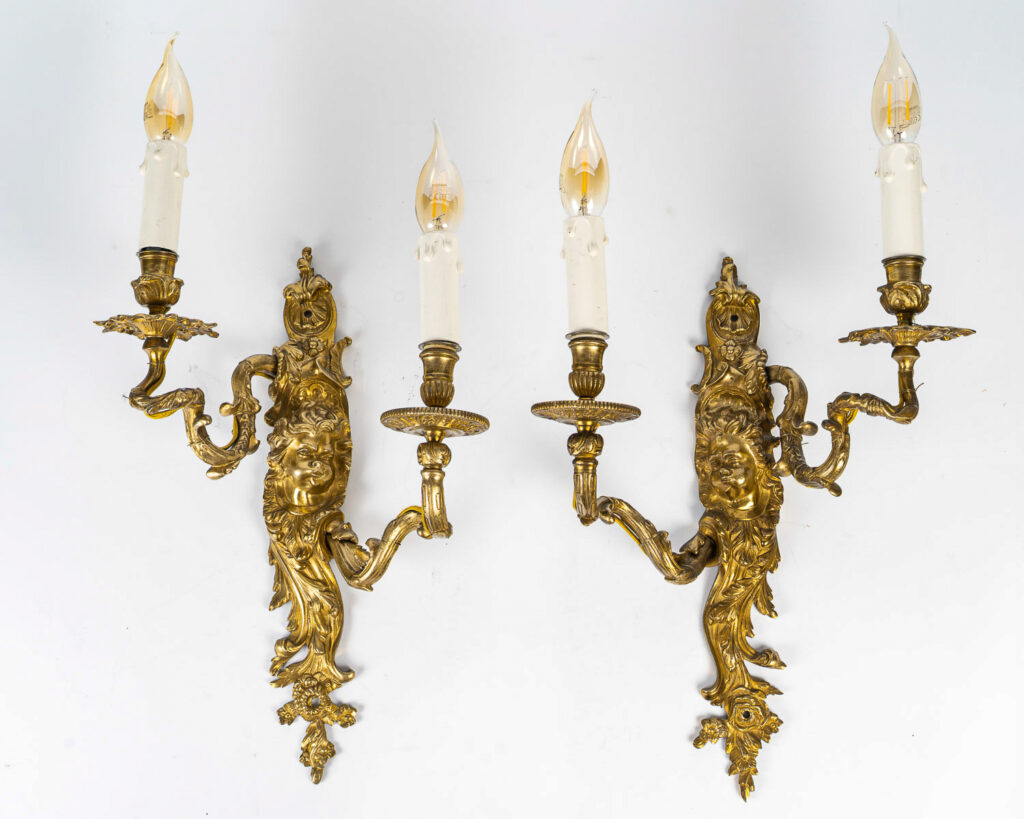
Pair of Zephyrs Wall Sconces in Chiseled and Gilded Bronze, 19th Century
Inspirée d’un modèle iconique du célèbre bronzier Jean-Joseph de Saint-Germain, cette paire d’appliques de style Louis XV se distingue par ses deux bras de lumière en bronze ciselé et doré. L’agrafe est ornée d’une tête de Zéphyr soufflant, entourée de feuilles d’acanthe et de rinceaux feuillagés en chute.
These sconces, crafted in France during the first half of the 19th century, are based on one of Saint-Germain's renowned designs.
Dimensions:
Height: 16.5 inches
Width: 11 inches
Depth: 6.3 inches
They are in good condition, with gilding showing slight wear that adds to their charm. Electrified, they are fitted with new opaline shades.
Jean-Joseph de Saint-Germain (1719-1791).
Probably the most famous Parisian bronzier of the mid-18th century, Jean-Joseph de Saint-Germain was active from 1742 and became a master in July 1748. He is best known for his clock cases and cartels, such as the "Diana the Huntress" cartel (an example is preserved at the Louvre Museum) and the clock supported by two Chinese figures (a model is visible at the Musée des Arts Décoratifs in Lyon). He also created several animal-themed clocks, notably with elephants and rhinoceroses (example at the Louvre Museum).
In the early 1760s, Saint-Germain played a key role in the revival of Parisian decorative arts and the development of the neoclassical style. He created, among other works, the "Genius of Denmark" clock based on a model by Augustin Pajou for Frederick V of Denmark (1765, preserved at Amalienborg in Copenhagen). He also produced several clocks on the theme of Study, based on a model by Louis-Félix de La Rue (examples at the Louvre, the Gulbenkian Foundation in Lisbon, and the Metropolitan Museum of New York).
In addition to his clock creations, Saint-Germain produced numerous decorative bronzes, including andirons, sconces, and candelabras, always demonstrating great creativity and exceptional skill. He retired from business in 1776.