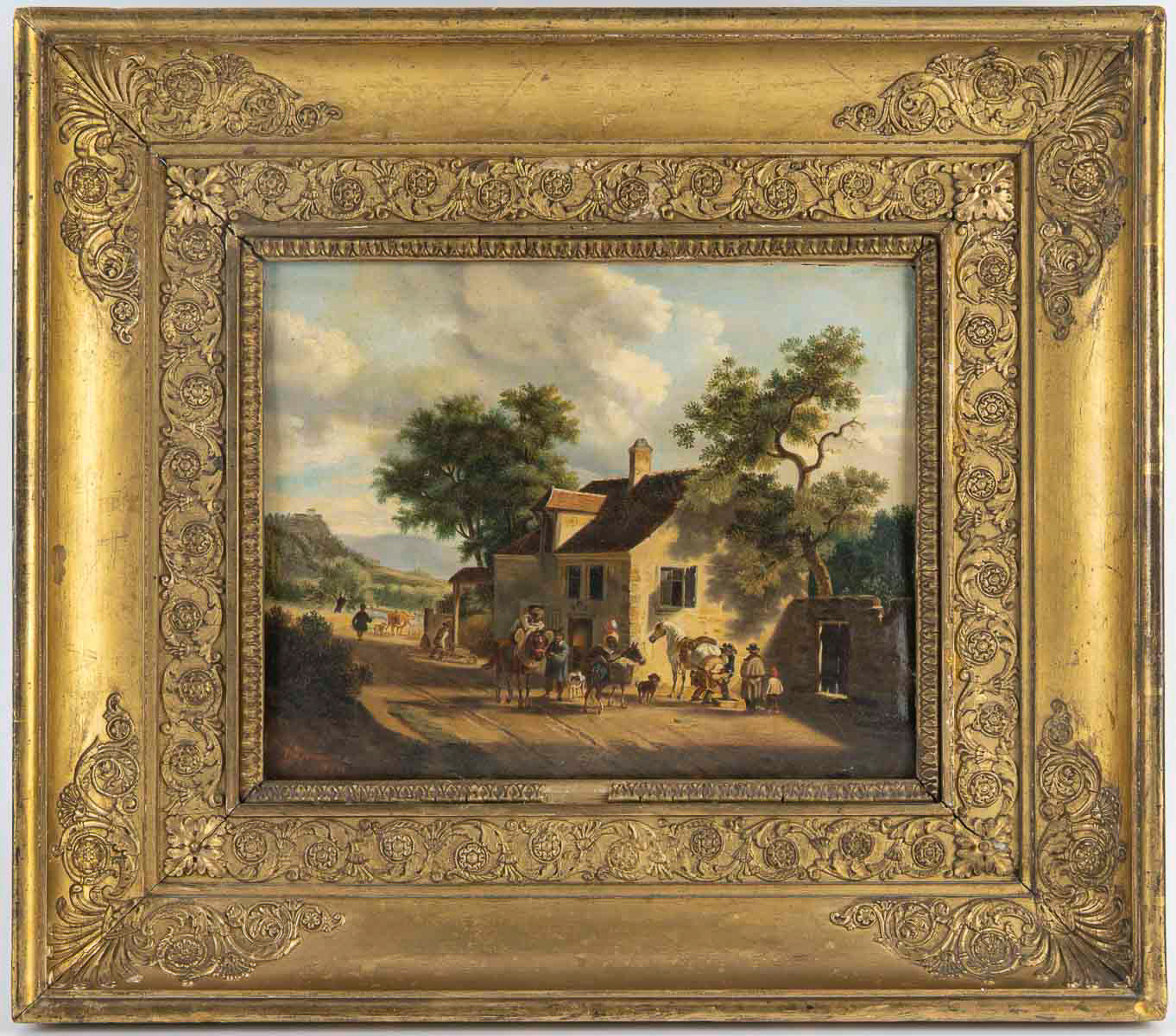
Jean-Louis Demarne (1744–1829) Rest at the Blacksmith’s Oil on canvas, circa 1824
This charming and lively scene captures early 19th-century rural life with remarkable quality, depicting a necessary stop at the blacksmith’s to tend to a horse—a common and essential moment in countryside living.
This fine oil on canvas is signed lower left and dated 1824.
Dimensions:
Without frame: Height 8.3 in – Width 10.2 in
With frame: Height 15.4 in – Width 17.3 in
Condition:
In good condition, the painting has been relined and is presented in its original, beautifully carved and gilded wood frame.
Biography:
Jean-Louis Demarne (1752–1829): Painter of Everyday Life and Witness to His Time
Jean-Louis Demarne (Bruxelles 1752 – Paris 1829) : Peintre de la vie quotidienne et témoin de son époque
Born in Brussels around 1752, Jean-Louis Demarne moved to Paris at a young age following the death of his father, an officer stationed in Belgium. There, he became a pupil of the painter Gabriel Briard and developed his artistic skills in the vibrant Parisian milieu. His style was characterized by precision and realism, earning him recognition from the Académie Royale de Peinture et de Sculpture in 1783—not for his ambitions in history painting, but for his exceptional talent in depicting animals and genre scenes, inspired by 17th-century Dutch masters.
Demarne distinguished himself through his lively, airy compositions, often focusing on rural life, village fairs, inns, and landscapes. Works such as "Rest at the Inn" and "Village Fair" vividly capture the atmosphere of the countryside and the daily lives of its people, foreshadowing the realism and attention to detail that would later define the Pre-Romantic movement. Unlike many of his contemporaries who drew inspiration from antiquity, Demarne looked to the Middle Ages and the 17th century, creating scenes brimming with life and movement.
The French Revolution did not hinder his career; he continued to receive official commissions, including from Dominique Vivant-Denon, who entrusted him with historical paintings such as "The Meeting of the Emperor and the Pope in the Forest of Fontainebleau." In recognition of his talent, he was granted lodging at the Sorbonne and was awarded the Legion of Honor in 1828, shortly before his death.
Museums:
His body of work is extensive, characterized by small formats and lively, open compositions.
His canvases, now preserved in prestigious collections, bear witness to his keen observational skills and technical mastery—offering a precious glimpse into the society of his time.
Several of his paintings are displayed at the Musée du Louvre.
His work is also well represented in provincial museums such as Amiens, Besançon (The Comtois Wedding), Cherbourg, Dijon, Dunkerque, Sèvres, Montpellier, and Quimper.
Russian museums in Saint Petersburg and Moscow also feature his paintings.
Sources:
Jacques Watelin, Le peintre J.-L. De Marne, La Bibliothèque des Arts, édition originale, Paris-Lausanne, 1962.
Wallace Collection Londres.
Encyclopédie Larousse.
Musée de Grenoble.
Musée du Louvre.
This article includes excerpts from the Dictionnaire Bouillet.