Georges Jacob Master in 1765 A Large Transition Louis XV-Louis XVI Period Armchair Circa 1765–1775
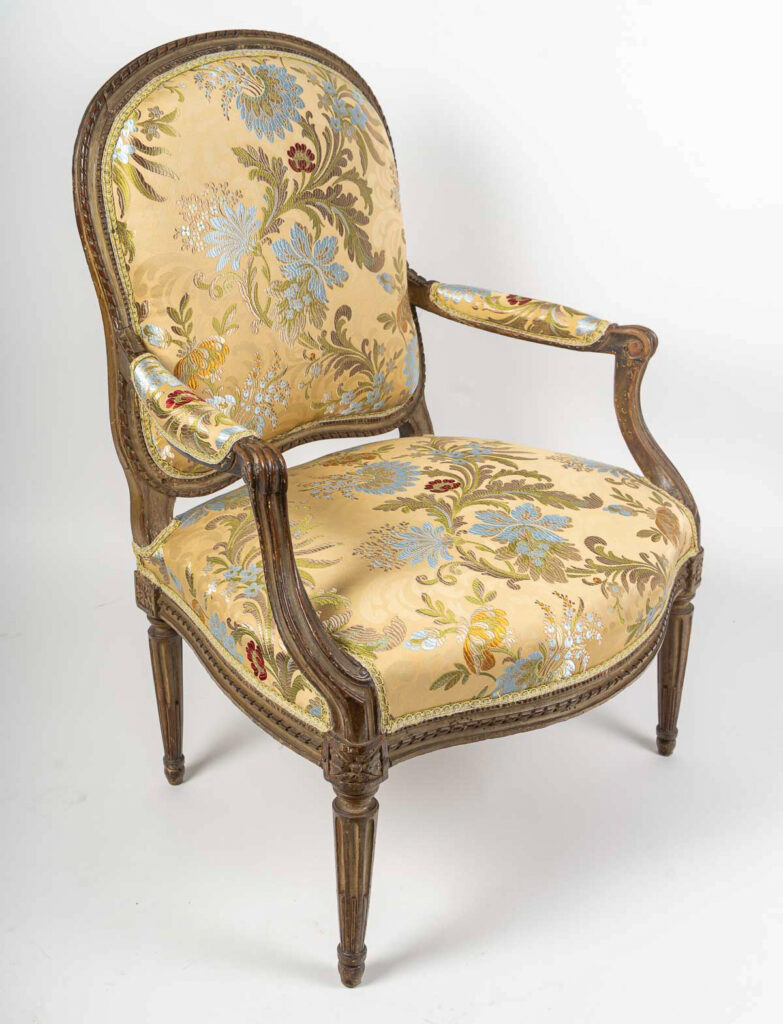
Of museum quality, Transition period armchairs stamped by Georges Jacob are relatively rare. They feature the dossier à la Reine (Queen’s backrest), the subtle curves characteristic of the late Louis XV period, and the straight, tapered, fluted legs with rudded grooves and carved ribbons typical of the early Louis XVI era. The most remarkable examples are the most restrained, their elegant lines—accentuated by delicate, fluid moldings—showcasing Georges Jacob’s exceptional skill.
This refined and substantial armchair, with its dossier à la Reine backrest, is crafted from antique beechwood, originally lacquered, and adorned with fine moldings and carved ribbon motifs. The whiplash-shaped armrest supports rest on slender, tapered legs.
Our Transition period armchair, stamped by Georges Jacob (who became a master craftsman in 1765), exemplifies the seamless blend of Louis XV grace and Louis XVI restraint.
Dimensions:
Height: 38.19 inches (97 cm)
Width: 27.17 inches (69 cm)
Seat depth: 22.83 inches (58 cm)
Seat height: 16.54 inches (42 cm)
This armchair has been expertly restored and is in excellent condition.
Beau travail de tapisserie, ce siège est recouvert à neuf d’un élégant tissu à motif floral jaune.
Biography:
Georges Jacob (1739-1814) - Master on September 4, 1765.
He is the most famous and the most creative of all the cabinetmakers of the 18th century in France.
His rich clientele included the royal family.
Georges Jacob was born in 1739 in Cheny in the Burgundy region. Son of Etienne Jacob and Françoise Beaujan, ploughmen.
He arrived in Paris at a very young age in 1755 as an apprentice carpenter with Jean-Baptiste Lerouge, established on rue de Charenton. He then joined Louis Delanois, the supplier of Madame du Barry, mistress of Louis XV, as a journeyman. The promoter of the neoclassical style in the seat, Delanois undoubtedly influenced Jacob's models.
Received master in 1765 thanks a small gilded wooden seat, Jacob then created his own workshop.
Two years later, he married Jeanne-Germaine Loyer from a family of master embroiderers.
Established in his first years on rue de Cléry, his workshops were moved in 1775 to rue Meslée where the most favorable period of his career took place and where the greatest royal orders were executed.
Georges Jacob is an innovator: it is also in the arrangement and decoration of the legs and arms of his seats that we find formulas launched if not imagined by him. Many of his chairs rest on tapered legs with rudentine flutes. These feet are connected to the belt by a die or case, decorated with a rose.
References:
Le Mobilier Français du XVIIIème Siècle – Pierre Kjellberg – Les Éditions de l’Amateur – 2002.
Les ébénistes du XVIIIe siècle – Comte François de Salverte – Les éditions d’Art et d’Histoire – 1934.
Musée Marmottan Paris.