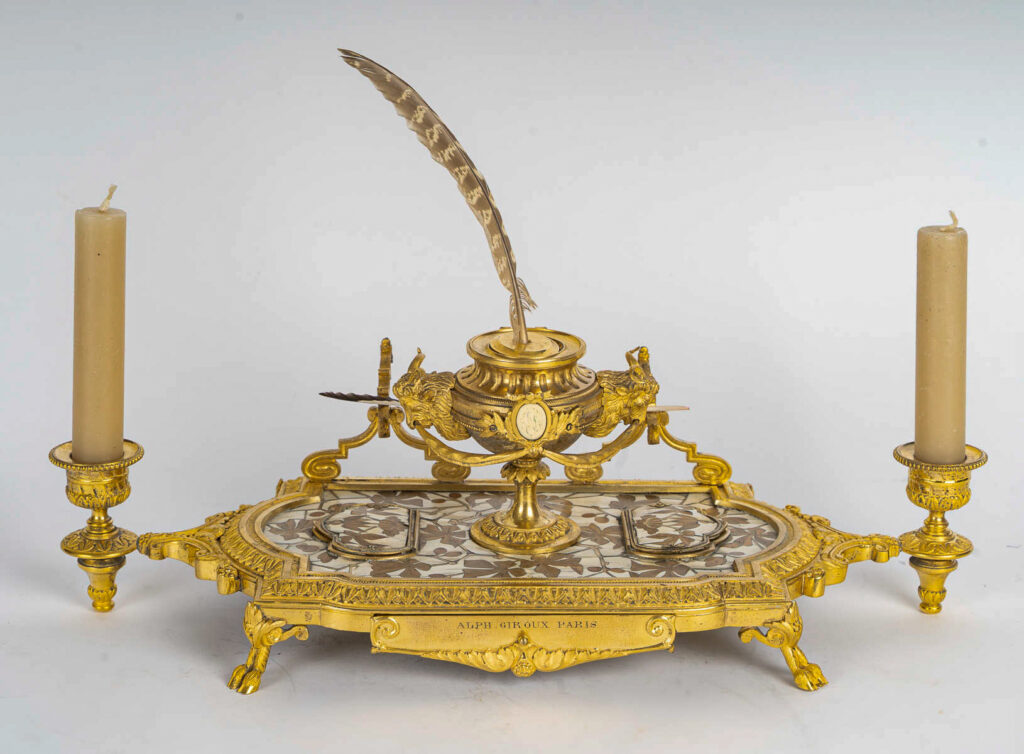
Ferdinand Duvinage (1823–1876) Bronze and Cloisonné Ivory Marquetry Inkwell, Maison Alphonse Giroux, c. 1880
Description: :
This finely chased and gilded bronze inkwell is distinguished by its decorative ram’s heads framing a monogrammed medallion. The tray features two small lateral compartments for quills and two symmetrical candlesticks, with a discreet drawer in the center. The ensemble rests on four claw feet, combining elegance and functionality.
The cloisonné ivory marquetry, inlaid with brass and adorned with branch motifs, leaf friezes, and scrollwork, showcases exceptional craftsmanship. The piece bears the initials FD integrated into the design, accompanied by the mark Bté(patented), along with the signature Alphonse Giroux à Paris on the drawer. These details confirm its authenticity and prestigious provenance.
Historical Context: :
Created around 1880, this inkwell exemplifies the excellence of Maison Alphonse Giroux under the leadership of the Widow Duvinage, who refined and patented the cloisonné marquetry technique in 1877, building on Ferdinand Duvinage’s innovations. This process, combining ivory, metals, and precious woods, embodies the sophistication of 19th-century decorative arts and the era’s fascination with Japonisme.
Dimensions:
Length: 15.35 inches (39 cm)
Height: 5.12 inches (13 cm)
Depth: 6.30 inches (16 cm)
Condition: :
In excellent condition, this piece retains its original signatures—both on the drawer and within the marquetry—as well as its authentic charm and character.
Biographies:
Ferdinand Duvinage (1823–1876)
Ferdinand Duvinage, born in 1823, was a renowned Parisian artisan and art dealer celebrated for his mastery of cloisonné ivory marquetry. The son of a stationer, he began his career in 1863 with a shop specializing in paintings and fans.
In 1867, he took over the esteemed Maison Giroux, founded around 1790 and known for its artist supplies, frames, easels, and luxury goods. Under his direction, the firm, located on Boulevard des Capucines in Paris, flourished, distinguished by the quality and originality of its creations.
Duvinage developed a cloisonné marquetry technique that combined ivory, precious metals, and wood, often inspired by Japonisme, a style highly fashionable at the time.
His works, showcased at the 1878 Paris Universal Exhibition, were praised for their luxury and technical skill. Ferdinand Duvinage passed away in 1876, leaving behind a legacy of excellence in 19th-century decorative arts.
The Widow Duvinage (1876–1882)
À la mort de Ferdinand Duvinage, sa veuve, Rosalie Duvinage, prend la tête de la Maison Giroux.
Elle perpétue et enrichit l’héritage de son époux en déposant, en 1877, un brevet pour une nouvelle technique de marqueterie sur ivoire cloisonné, intégrant parfois des incrustations de nacre. Les objets produits sous sa direction, souvent estampillés « Veuve Duvinage » ou « FD Bte », sont aujourd’hui recherchés pour leur rareté et leur qualité.
La production cesse en 1882, lorsque la veuve Duvinage met fin à l’activité de la maison.
Ses créations, marquées par une esthétique raffinée et une maîtrise technique remarquable, continuent de fasciner les collectionneurs et les musées, comme en témoigne le cabinet conservé au Musée d’Orsay.
Maison Alphonse Giroux: A Legacy of Parisian Excellence
Founded in Paris in 1799 by François-Simon-Alphonse Giroux, Maison Alphonse Giroux established itself as one of the most prestigious luxury houses of the 19th century. Initially located at 7 rue du Coq-Saint-Honoré and later moved to 43 boulevard des Capucines in 1857, it embodied the perfect blend of exceptional craftsmanship and French elegance.
In its early years, the firm specialized in creating fancy goods, stationery, artists' supplies, and fine cabinetry. Trained in painting by Jacques-Louis David and renowned for his skill as an art restorer and cabinetmaker, François-Simon-Alphonse Giroux quickly distinguished his brand through the quality and originality of his creations. The house became the preferred supplier to Parisian aristocracy and high society, earning its founder the nickname "merchant to the princes."
In 1838, his sons, Alphonse-Gustave and André, took over and expanded the business. They developed a diverse range of refined furniture, tabletterie (small luxury items), and technical innovations, including the first daguerreotype cameras, produced in collaboration with Louis Daguerre. Their participation in the 1839 Exposition des Produits de l’Industrie, awarded a silver medal, solidified their reputation as leaders in luxury and innovation.
Maison Giroux also left its mark on the cultural and political life of its time. It provided official gifts for the "Enfants de France" during the reigns of Louis XVIII and Charles X and created remarkable pieces, such as the golden carriage presented to the children of the Duc de Berry in 1824, now displayed at the Musée Carnavalet. Its creations, combining elegance and masterful craftsmanship, adorned imperial palaces and the most prestigious residences, including the bonheur-du-jour acquired by Empress Eugénie for the Palace of Compiègne at the 1855 Exposition Universelle.
In 1867, the business was taken over by Duvinage and Harinbouck, then managed by Ferdinand Duvinage and his widow, before finally being acquired by A. Philippe and E. Arnut. Despite these transitions, Maison Giroux’s reputation for excellence endured until its closure in 1885.
Today, objects bearing the Alphonse Giroux signature are highly sought after by collectors and museums worldwide, serving as enduring symbols of the golden age of Parisian craftsmanship and the splendor of the 19th century.