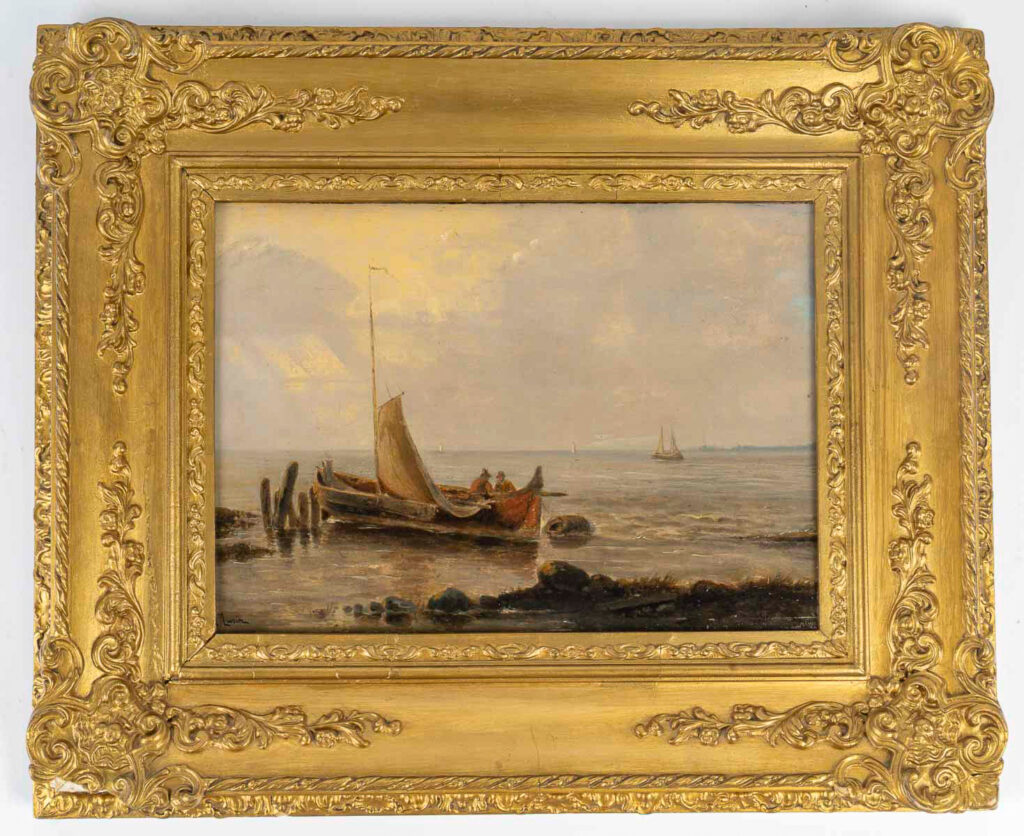
Auguste Henri Musin (1852–1923) – The Fishermen, Oil on Panel, c. 1890-1900
A captivating painting where enchanting light captures the very essence of a serene fishing day.
This oil on mahogany panel, signed lower left by Auguste Musin, delicately depicts a peaceful fishing scene. The soft, harmonious color palette evokes a sense of calm, while every detail enhances the realism and poetry of the moment. The work is elevated by its original carved and gilded wood-and-composition frame, characteristic of the period.
Dimensions:
Panel only: Height 6 ¼ in - Width 8 ⅝ in
Framed: Height 11 ⅞ in - Width 14 ⅛ in.
Condition:
In excellent state of preservation, this painting is presented in its original condition, further distinguished by its period carved and gilded wood-and-composition frame, which accentuates its elegance.
Biography:
Auguste Musin – A Sensitive Eye for the Sea
Born in Ostend in 1852, Auguste-Henri Musin stands among the foremost Belgian marine painters of the late 19th and early 20th centuries. Trained by his father, the renowned artist François Musin, he developed an early fascination with coastal landscapes and maritime life. Settling in Brussels, he refined a style that combined technical precision with a keen sensitivity to light and the shifting atmospheres of ports and shorelines.
A master of harbor scenes, ships, and fishing life, Musin had a unique ability to convey the soul of a place and the daily lives of those who worked the sea. His travels, particularly to Italy, broadened his artistic vision and enriched his palette, as seen in his views of Venice, now held in prestigious collections.
Acclaimed for his skill, Musin exhibited widely in Belgium and abroad, contributing to the reputation of the Belgian school of marine painting. His works—whether in oil or watercolor—are marked by a delicate balance between documentary accuracy and artistic emotion.
He passed away in Saint-Josse-ten-Noode in 1923, but his legacy endures. His body of work, both rigorous and evocative, remains a vibrant testament to the golden age of European marine painting. His canvases can be admired in the museums of Ostend, Ixelles, and Brussels, where they continue to captivate art lovers.