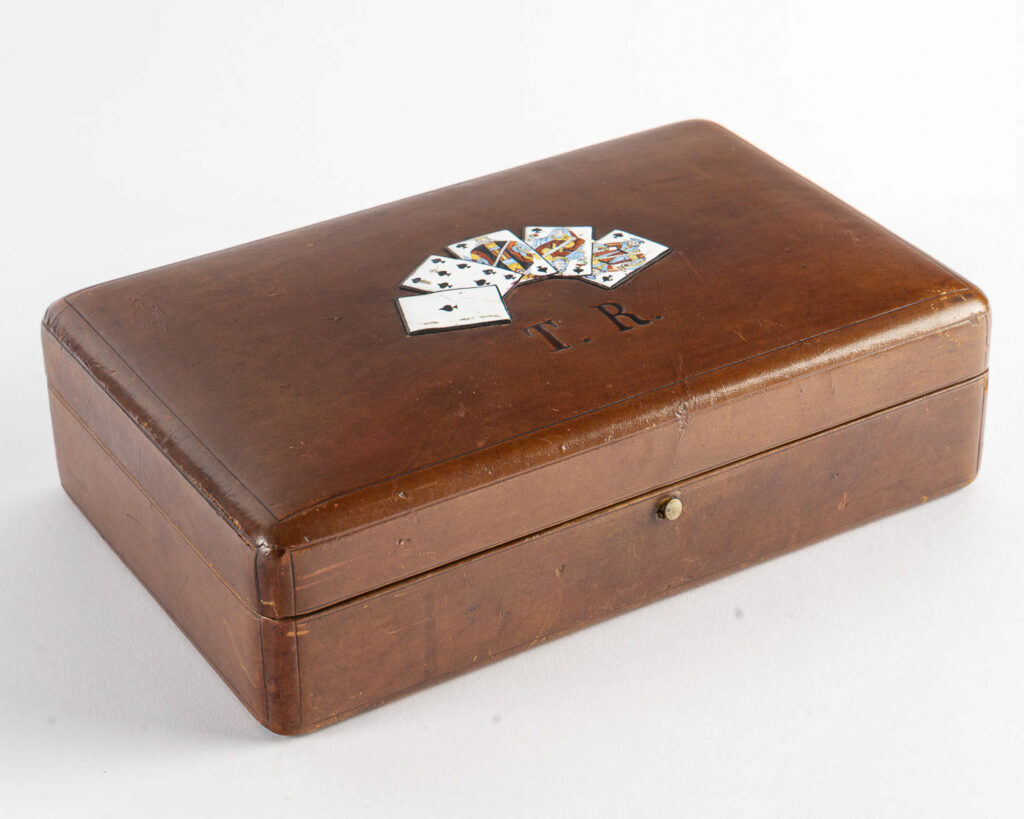
Small Leather and Enamel Game Box by Maison Alphonse Giroux, c. 1850
This elegant leather game box contains two antique decks of 32 playing cards, paper markers, tokens, and a gilded metal pencil. Its lid, adorned with inlaid enamel playing card motifs, showcases the refined craftsmanship of Maison Alphonse Giroux. The box is signed on the clasp, preserving its original authenticity and charm.
Dimensions:
Length: 8.3 inches
Height: 2.4 inches
Depth: 5.3 inches
Condition:
In excellent condition, this piece retains all its original authenticity and charm.
Maison Alphonse Giroux: A Legacy of Parisian Excellence
Founded in Paris in 1799 by François-Simon-Alphonse Giroux, Maison Alphonse Giroux established itself as one of the most prestigious luxury houses of the 19th century. Initially located at 7 rue du Coq-Saint-Honoré and later moved to 43 boulevard des Capucines in 1857, it embodied the perfect blend of exceptional craftsmanship and French elegance.
In its early years, the firm specialized in creating fancy goods, stationery, artists' supplies, and fine cabinetry. Trained in painting by Jacques-Louis David and renowned for his skill as an art restorer and cabinetmaker, François-Simon-Alphonse Giroux quickly distinguished his brand through the quality and originality of his creations. The house became the preferred supplier to Parisian aristocracy and high society, earning its founder the nickname "merchant to the princes."
In 1838, his sons, Alphonse-Gustave and André, took over and expanded the business. They developed a diverse range of refined furniture, tabletterie (small luxury items), and technical innovations, including the first daguerreotype cameras, produced in collaboration with Louis Daguerre. Their participation in the 1839 Exposition des Produits de l’Industrie, awarded a silver medal, solidified their reputation as leaders in luxury and innovation.
Maison Giroux also left its mark on the cultural and political life of its time. It provided official gifts for the "Enfants de France" during the reigns of Louis XVIII and Charles X and created remarkable pieces, such as the golden carriage presented to the children of the Duc de Berry in 1824, now displayed at the Musée Carnavalet. Its creations, combining elegance and masterful craftsmanship, adorned imperial palaces and the most prestigious residences, including the bonheur-du-jour acquired by Empress Eugénie for the Palace of Compiègne at the 1855 Exposition Universelle.
In 1867, the business was taken over by Duvinage and Harinbouck, then managed by Ferdinand Duvinage and his widow, before finally being acquired by A. Philippe and E. Arnut. Despite these transitions, Maison Giroux’s reputation for excellence endured until its closure in 1885.
Today, objects bearing the Alphonse Giroux signature are highly sought after by collectors and museums worldwide, serving as enduring symbols of the golden age of Parisian craftsmanship and the splendor of the 19th century.